
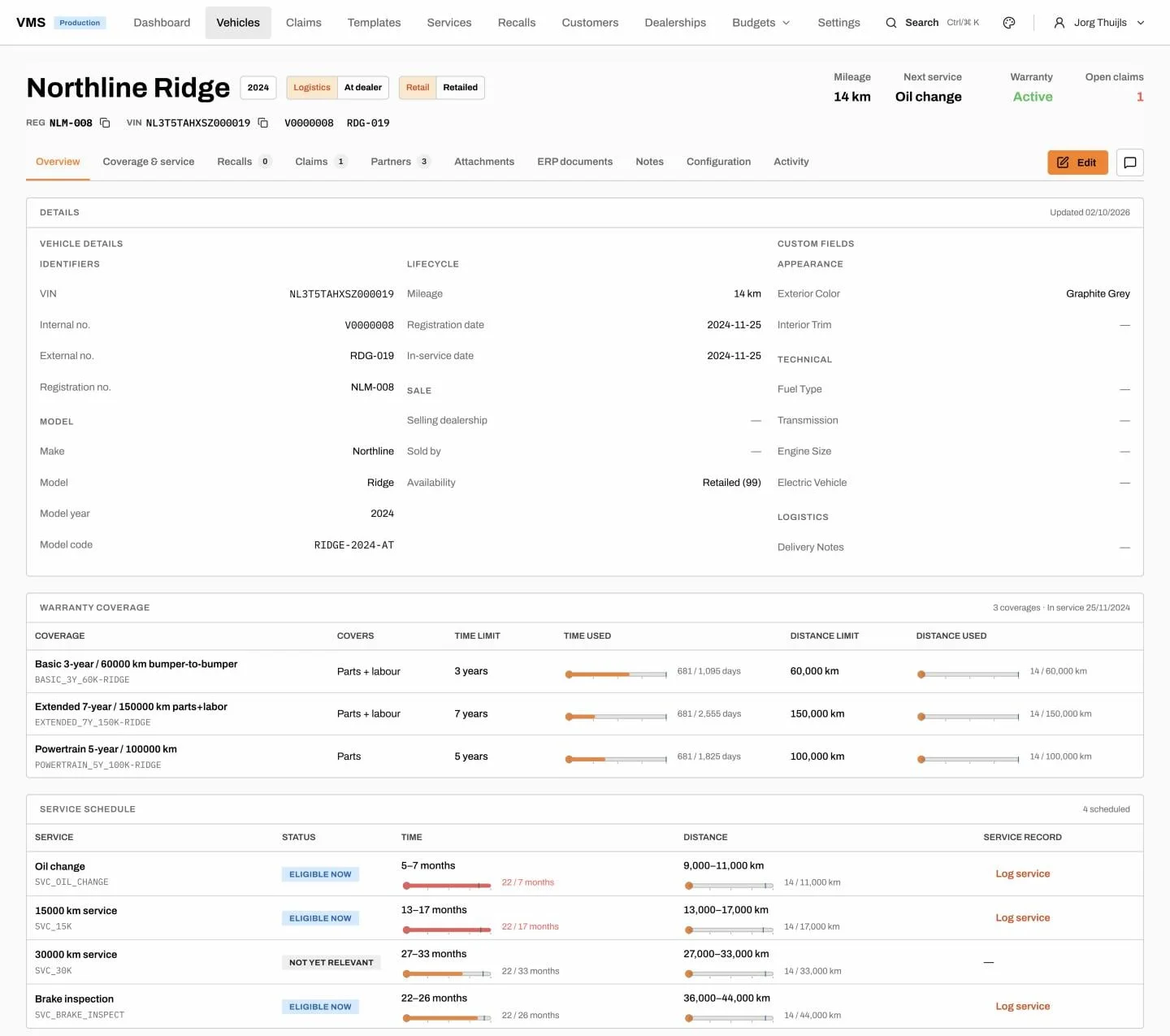
If you import vehicles, motorcycles, machinery or boats and sell through dealers, you need a system that tracks each unit by VIN or serial number from the factory order to the end of its warranty. Most accounting packages and many standard ERPs track stock by quantity. They do not hold a record for each unit. That gap is where spreadsheets, manual claims and margin leaks appear.
This guide is for importers and distributors of cars, motorcycles, machinery, ag equipment, marine and powersports, and their dealer networks. It covers the process chain, where generic systems struggle, your options and a checklist to test any proposal.
The process chain an importer actually runs
A distributor’s year is a loop. Each step depends on the one before it.
- Forecast and indent. You forecast demand by model, variant and colour, then place indents or orders with the factory, often months ahead.
- Production and shipping. Units are built, allocated VINs or serials, and shipped. You need to know which unit is on which vessel and when it lands.
- Landed cost. Freight, insurance, duty, port charges, brokerage and any local fitment build up the true cost of each unit. Costs often arrive on separate bills, weeks apart.
- Import and compliance. For road vehicles, import approval and the Register of Approved Vehicles (RAV) steps must be complete before a unit can be supplied to the market and registered. More on this below.
- Allocation to dealers. Scarce stock is allocated to dealers by rules: sales performance, stock on hand, regional needs.
- Dealer orders and stock. Dealers order from allocation or from stock. You track where each unit sits: in transit, at port, in your yard, at a dealer.
- Pre-delivery. Pre-delivery inspection (PDI), accessories and fitment are done and recorded against the unit.
- Sale and handover. The dealer retails the unit. The warranty clock starts.
- Warranty claims and supplier recovery. Dealers lodge claims. You validate them against the unit’s history and warranty terms, pay the dealer, then recover eligible costs from the manufacturer.
- Parts. Parts supply runs alongside, for both warranty and paying customers.
Every step needs the unit’s identity.
Why generic systems struggle
Small business accounting tools
Xero and MYOB handle ledgers, GST and payroll well. They are not built to hold a record for each vehicle with its build data, shipping status, compliance status, dealer, owner and claim history. Importers using them end up running the real business in spreadsheets.
Standard ERPs
A standard ERP can track serial numbers. Odoo, for example, supports tracking by unique serial number or by lot, and has a landed costs feature that spreads freight, duty and other charges across a receipt equally, or by quantity, cost, weight or volume. Those are useful foundations.
What standard ERPs do not usually include out of the box is the automotive layer:
- A vehicle record that carries VIN, model, variant, build date and compliance status through its whole life.
- Allocation rules that distribute scarce units across a dealer network.
- Warranty terms per model and market, claim validation against unit history, labour times and parts, and recovery from the manufacturer.
- A dealer-facing portal so dealers can order, see allocations and lodge claims without email.
Building all of that by customising an ERP is possible. It is also where projects become expensive and hard to upgrade.
Australian specifics to plan for
Landed cost
Australian importers pay freight, insurance, customs duty where it applies, and port and broker fees. Your ERP must capture these costs against the right units, even when the bills arrive after the stock. If it does not, your margin per unit is a guess.
GST at import and the deferred GST scheme
GST is normally payable on taxable imports when goods are cleared. Under the ATO’s deferred GST scheme, an eligible importer can defer that GST and report it on the monthly BAS instead. The ATO’s criteria include having an ABN, being registered for GST, and lodging and paying the BAS monthly and electronically. Customs duty, where it applies, is still paid at import. Your system should record import GST correctly whichever way you handle it. Talk to your tax adviser about eligibility.
Road Vehicle Standards Act and the RAV
The Road Vehicle Standards Act 2018 replaced the Motor Vehicle Standards Act 1989 on 1 July 2021. Under it:
- You need an approval before importing a road vehicle into Australia.
- New road vehicles are entered on the Register of Approved Vehicles (RAV), a Commonwealth database. The RAV replaced the need to fit identification plates.
- Each vehicle is identified on the RAV by its VIN, along with details such as make, model, build date and approval number.
- Entries are made through one of two pathways: vehicle type approval or concessional RAV entry approval.
- RAV entry is almost always needed before a state or territory will register the vehicle.
For a distributor, this means compliance is a per-unit status that must be tracked and evidenced before the unit is supplied to a dealer. The RAV covers road vehicles, including trailers and motorcycles. Boats and many off-road machines follow different rules, so your system should handle compliance steps that vary by product line.
Your options
| Option | What it looks like | Strengths | Watch-outs |
|---|---|---|---|
| SAP with custom builds | SAP ERP with automotive add-ons or bespoke development for vehicles and warranty | Very capable at scale. Proven with large brands. | High licence and build cost. Custom code adds upgrade effort. Specialist skills are scarce and expensive. |
| Standard Odoo | Odoo Inventory, Purchase, Sales, Accounting with serial tracking and landed costs | Lower cost. Fast to deploy. Strong core finance and stock. | No vehicle-specific allocation, compliance or warranty claims out of the box. Gaps get filled with customisation or spreadsheets. |
| Odoo or SAP plus a specialist vehicle and warranty layer | Your ERP runs finance, stock and purchasing. A vehicle platform such as Fleetlane runs allocation, orders, shipping, delivery and warranty claims. | Each system does what it is good at. The ERP stays close to standard. | Needs a clean integration design. Two systems to support. |
There is no single right answer. A large importer with an established SAP team may keep SAP and add a vehicle layer. A growing distributor may move to Odoo and add the same layer. See Odoo vs SAP S/4HANA for a wider comparison, and What it really costs to leave SAP for Odoo if you are weighing a move.
Where Fleetlane fits
Fleetlane is EnCollab’s vehicle management system. It is a standalone SaaS that gives each vehicle its own record, from the allocation plan through ordering, shipping (voyages and customs), delivery to dealers, warranty claims and recalls. It works alongside SAP or Odoo: sales orders, invoices and credit notes stay in the ERP, and Fleetlane references them by document number.
Related products complete the picture:
- Warranty handles dealer claims, validation and supplier recovery, and runs on SAP, Odoo or SAP Public Cloud.
- Partner Portal gives dealers one place to order, check stock and pricing, and handle aftersales tasks. It is built on SAP, so it suits distributors running SAP.
- Survely collects customer feedback after sale and service and writes responses back to the source record.
Our team brings more than 30 years of SAP experience, including delivering SAP for vehicle brands such as Toyota, Subaru, Kubota and Hino. EnCollab is an SAP partner and an Odoo Silver partner.
An example. A New Zealand automotive distributor was heading towards SAP. After reviewing its options, it chose Odoo with EnCollab’s vehicle and warranty capability instead. Finance, stock and purchasing run in standard Odoo. The vehicle and warranty work runs in a layer designed for it.
The dealer side
Your dealers are your customers, and your system shapes their experience. Things that matter to dealers:
- Seeing their allocation and stock in transit without phoning you.
- Ordering units and parts in one place.
- Lodging warranty claims with photos and job details, and seeing claim status.
- Fast, predictable claim payments.
A portal reduces calls, errors and disputes on both sides.
Requirements checklist
Use this table to test any proposal, whichever system it is built on.
| Requirement | Must have | Questions to ask |
|---|---|---|
| Unit record by VIN or serial | Yes | Does every unit carry its own record from indent to end of warranty? |
| Forecast and factory orders | Yes | Can we order by model, variant and colour and track against confirmations? |
| Shipping visibility | Yes | Can we see which units are on which shipment, with ETA? |
| Landed cost by unit | Yes | Can late bills for freight and duty be applied to units already received? |
| Import GST and duty | Yes | How are import GST, deferred GST and duty recorded? |
| Compliance status | Yes (road vehicles) | Can we record import approval and RAV status per VIN and block supply until complete? |
| Dealer allocation | Yes | Can allocation rules be set and changed without code? |
| Dealer orders and stock location | Yes | Do we know where every unit is: port, yard, dealer? |
| Pre-delivery | Recommended | Can PDI and fitted accessories be recorded against the unit? |
| Warranty claims | Yes | Are warranty terms configurable by model and market? Are claims checked against unit history? |
| Supplier recovery | Yes | Can we track what we claim back from the manufacturer and reconcile it? |
| Parts | Recommended | Are warranty parts and customer parts handled in the same stock? |
| Dealer portal | Recommended | Can dealers order, see allocations and lodge claims themselves? |
| Customer feedback | Optional | Can we survey owners after sale and service? |
| Upgradeability | Yes | How much custom code is in the core ERP? |
Honest caveats
- A specialist layer adds an integration. Plan who owns it and how it is tested.
- Compliance rules differ between road vehicles, marine and off-road machinery. Get compliance advice for your product lines.
- Data migration from an old system is often the hardest part. Unit history and open claims need careful handling.
Next step
If you import or distribute vehicles, machinery or marine products and want to see how this works in practice, book a Fleetlane and Odoo demo. We will walk through your process chain and show where each step lives.
If you are on SAP today and weighing a move, book a free SAP Exit Assessment for a first view of what it might involve.
FAQ
What is the best ERP for a vehicle importer in Australia?
There is no single best system. The right choice depends on your size, your existing ERP and how complex your warranty and dealer processes are. Many importers run a standard ERP such as Odoo or SAP for finance and stock, with a specialist vehicle and warranty platform alongside it.
Can Odoo track vehicles by VIN?
Odoo can track products by unique serial number, which can hold a VIN. Vehicle-specific needs such as dealer allocation, compliance status and warranty claims usually need an added layer or customisation.
Does an ERP need to handle the Register of Approved Vehicles?
For road vehicles, RAV entry is almost always needed before a vehicle can be registered. Your system should record compliance status for each VIN so units are not supplied to dealers before they are ready. The RAV entry itself is made through the Department’s systems.
How do importers handle landed cost in an ERP?
Freight, insurance, duty and port fees are captured as landed costs and spread across the units in a shipment. A good system lets you apply bills that arrive after the stock and shows true cost per unit.
What is the deferred GST scheme?
It is an ATO scheme that lets eligible importers defer GST on imports and report it on their monthly BAS. Customs duty is still payable at import. Check eligibility with the ATO or your adviser.
Can Fleetlane work with SAP instead of Odoo?
Yes. Fleetlane works alongside SAP or Odoo, which stay the record for sales orders, invoices and credit notes.
Sources
- Department of Infrastructure, Guide to the Register of Approved Vehicles
- Department of Infrastructure, Register of Approved Vehicles
- Department of Infrastructure, Importing a road vehicle into Australia
- Department of Infrastructure, Vehicle type approvals
- ATO, Deferred GST scheme
- Australian Border Force, Deferral of GST
- Odoo 19 documentation, Landed costs
- Odoo 19 documentation, Lot and serial number tracking for products